Applied AI Leadership Cohort
A small, hands-on, three-month cohort for leaders who want to use AI tools to solve real problems inside their current roles. Not a course. Not a demo. Real work, with real tools, on your actual problems.
The goal is not to learn tools in isolation, but to build repeatable ways of working with AI that you can continue using after the cohort ends.
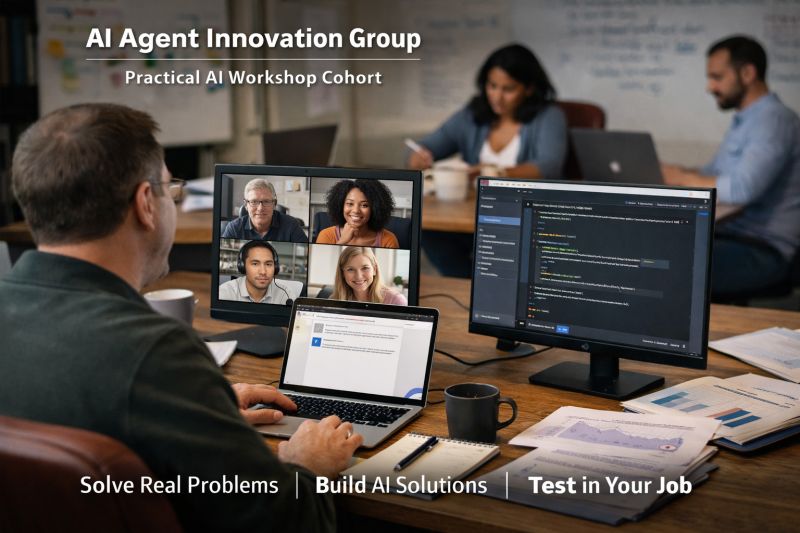
Who this is for
- People who already own work, decisions, or outcomes
- Managers, directors, senior practitioners, and trusted individual contributors
- No technical background required, but you should expect to actively build and test ideas tied to your own work
This is best suited for people who are responsible for outcomes and want to reduce cognitive load, sharpen judgment, and move work forward using AI.
What makes this different
This is not a general AI overview. It is not a certificate program. It is not a series of tool demos.
The focus is on building practical, repeatable solutions to problems you already face. Every session is oriented around judgment and real constraints, not hype or hypotheticals.
What kinds of problems people work on
This cohort is not about hypothetical projects. Participants use AI to work on real problems they already own.
Examples of the kinds of work people bring into the cohort include:
- Running regular reviews across multiple priorities and using AI to surface what's stalled, at risk, or needs attention next
- Preparing for high-stakes meetings by quickly synthesizing context, creating tailored materials, and testing ideas before decisions are made
- Turning messy notes, conversations, or inputs into clear plans with decisions, deliverables, and next steps
- Deciding what to push forward, what to pause, and what to stop when everything feels "almost done"
- Creating shared context or documentation so work doesn't live only in your head
You do not need a startup idea.
You do need real work you are responsible for.
Program structure
How the sessions work
Pricing
Full access to all six sessions over three months, including setup guidance and group working sessions.
Full access to all six sessions over three months, including setup guidance and group working sessions.
Optional. Focused, one-on-one help to accelerate or harden a specific solution tied to your work.
Personalized build support is optional and scoped transparently. You will know exactly what it covers before deciding.
Ready to join the next cohort?
Next start date is TBD. Register your interest below — we'll reach out as soon as the date is locked, and seats fill in the order interest comes in.
Register InterestWe don't use AI to chat. We use it to run our work.
This command center is one example of what's possible. Built with AI tools, it transforms a simple prompt into a structured briefing across multiple priorities, relationships, and initiatives. In the cohort, you'll learn to build similar systems tailored to your specific role and challenges.
What you're seeing: A command center we built internally to manage priorities, surface what's time sensitive, identify high-ROI actions, and flag initiatives that need attention.
This demonstrates the type of practical AI solution you'll learn to build — customized to your specific workflow and challenges. The exact metrics, structure, and focus areas would be entirely yours.
The hard part isn't capability. It's holding everything in your head at once. What's drifting. What's urgent. What only feels urgent. What actually matters this week.
Note: This demonstration uses illustrative data to show functionality. Your command center would reflect your actual projects, metrics, and priorities.
What each session looks like
A closer look at how the six sessions are structured and what you can expect to work on.
Session 1 Getting your work out of your head and onto the page
Most experienced professionals already know what they're doing. The problem is that too much of the work lives in their head. This session shows how to use AI to get that thinking out where you can actually work with it.
- Set up AI tools you can use day to day
- Take one real, current problem and put it into the tool as-is
- Watch AI help organize it without oversimplifying it
- See where things are unclear, stuck, or at risk
You should feel real relief in this session. If you don't, the cohort isn't doing its job.
Session 2 Using AI on your own work, not someone else's examples
This is where you stop watching demos and start using AI on your own problems. Some things will work better than expected. Some won't. That's the point.
- Bring a real situation you're currently wrestling with
- Use AI to turn rough notes into clearer plans or next steps
- Adjust and correct the AI when it misses context
- Leave with something you can actually reuse
This session helps shape what the rest of the cohort focuses on.
Session 3 Deciding what to push, pause, or stop
When everything feels important, decision-making suffers. This session focuses on using AI to help you see tradeoffs more clearly so you can decide what actually deserves attention.
- Competing projects or initiatives
- Work that's "almost done" but not quite ready
- Deciding where effort will actually pay off
The goal is not for AI to decide for you, but to make decisions easier to make.
Session 4 Explaining your decisions clearly
Many decisions fail not because they're wrong, but because they're poorly explained. This session focuses on using AI to help you clearly communicate your reasoning.
- Writing things others can understand without extra context
- Explaining tradeoffs to stakeholders or leadership
- Working through constraints like policy or compliance
AI helps you say what you already know, more clearly.
Session 5 Creating simple systems you can reuse
This session is about reducing future work. Instead of starting from scratch each time, you'll build simple structures you can reuse.
- Weekly or monthly reviews that actually help
- Repeatable ways to track pipelines, programs, or plans
- Using AI as part of an ongoing workflow, not a one-off tool
Session 6 Putting it all together and knowing the limits
The final session focuses on integration, not expansion. You'll decide where AI fits into your work and where it doesn't.
- Clear ways you plan to keep using AI
- Areas where you intentionally won't use it
- Confidence in your own judgment, not reliance on the tool
No hype. No "next level." Just clarity.
A note on flexibility: Sessions 3–6 adjust based on what people are actually working on, where AI helped the most, and where it caused friction. That's intentional. The cohort stays grounded in real work, not a fixed script.
Common questions
Who is this cohort for?
Who is this not for?
Is this a technical or coding program?
How is this different from AI courses or certifications?
What kinds of problems will participants work on?
How much time does this require?
Will sessions be recorded?
How is confidentiality handled?
How large is the cohort?
What will I have at the end?
What is the optional personalized build support?
Can my company pay or reimburse this?
How does this relate to AI Agent Innovation Group?
This is a pilot. It is not for everyone. The goal is real work, not passive learning. If you want to build something meaningful with AI inside your current role, this is the place to do it.